
Biometric Attendance vs Manual Attendance: Which is Better for Schools?
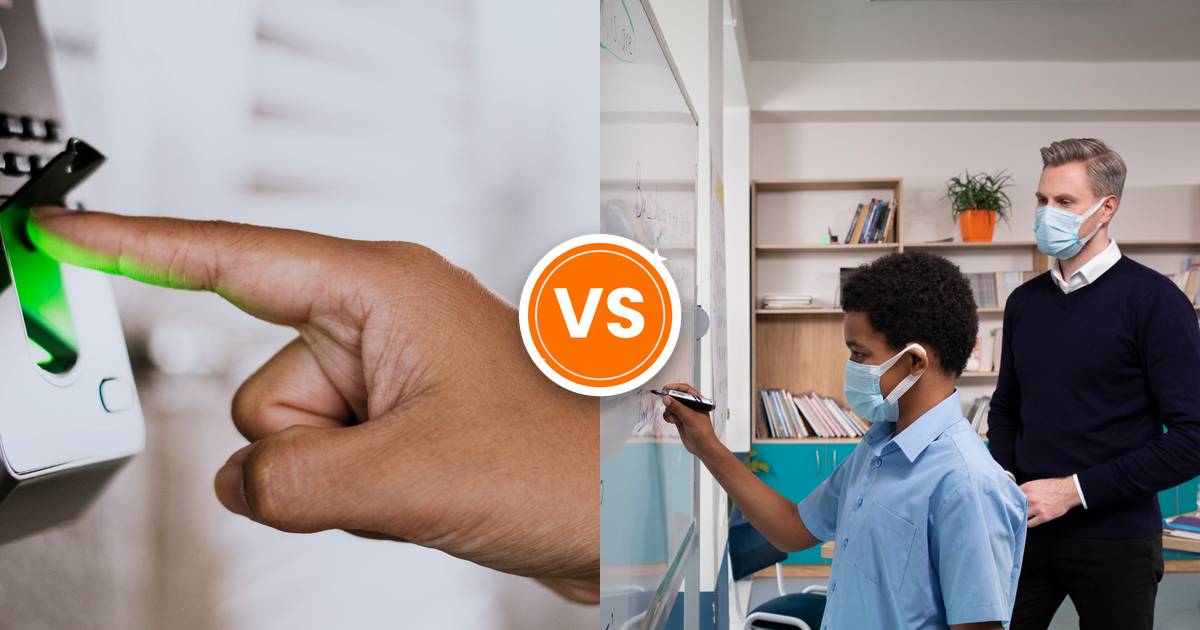
Biometric Attendance vs Manual Attendance Which is Better for Schools?
Biometric attendance uses fingerprint or face recognition to record student presence automatically and securely. Manual attendance relies on teacher roll call recorded on paper or spreadsheets. Biometric systems eliminate proxy marking, save 10-15 minutes of instructional time per class, and send real-time alerts to parents. Manual attendance costs less upfront but requires daily manual entry, offers no fraud prevention, and delays parent notification until monthly reports.
As of 2026, over 3,600 Indian schools and 2,400 Pakistani schools search for biometric attendance systems monthly, driven by government digitization mandates and parent demand for real-time visibility. This guide compares both methods across accuracy, time efficiency, cost, parent engagement, and compliance to help you choose the right system for your school.
What is Biometric Attendance?
Biometric attendance is an automated system that identifies students through unique biological characteristics—fingerprint, face, iris, or palm print—and records their presence electronically. When a student scans their finger or looks at a camera, the system matches the biometric template against the enrolled database and logs the attendance timestamp.
How it works:
- Enrollment — Students register their biometric data (fingerprint scan or facial image) once during admission or at the start of the academic year
- Daily capture — Students scan their finger on a device or stand before a camera at the school entrance or classroom door
- Verification — The system compares the live scan against the stored template using pattern-matching algorithms
- Recording — Attendance is logged automatically with student ID, date, time, and location
- Sync and notify — Data syncs to the school management system in real-time, triggering SMS or WhatsApp alerts to parents
Core biometric technologies used in schools:
- Fingerprint recognition — Most common in K-12 schools due to low device cost and mature technology; accuracy ranges from 95-99% for single-finger systems
- Facial recognition — Contactless alternative gaining adoption post-2020; accuracy varies by camera quality and lighting conditions (82-95% in school environments based on deployment studies)
- Iris recognition — Highest accuracy (98.2% with only 1.8% false rejection rate per ScienceDirect research) but rarely used in schools due to cost
Primary users: School administrators, teachers (monitoring dashboard), parents (real-time alerts via SMS/app), operations staff (device management)
Common in: Government schools with digitization mandates (38,000 Punjab government schools implementing biometric attendance by 2026 directive), private schools prioritizing parent engagement, boarding schools tracking hostel attendance
What is Manual Attendance?
Manual attendance is the traditional method where teachers call out student names or visually verify presence and record attendance on paper registers, spreadsheets, or basic digital forms. The record is later transcribed into the school's information system or compiled into monthly reports.
How it works:
- Roll call — Teacher calls each student's name or checks off names from a printed roster at the start of class
- Recording — Teacher marks present (P), absent (A), late (L), or excused (E) on a paper register or Excel sheet
- Daily submission — Completed attendance sheets are submitted to the school office at the end of the day
- Manual entry — Office staff or teachers manually enter attendance data into the school management system or maintain physical registers
- Monthly compilation — Attendance percentages are calculated at month-end and sent to parents in printed monthly reports or report cards
Variants of manual attendance:
- Paper register — Handwritten attendance in bound registers; prone to tampering and difficult to aggregate
- Excel spreadsheet — Teachers maintain class-wise Excel sheets; faster calculation but still requires manual daily entry
- Google Forms / basic digital forms — Teachers submit attendance via online forms; reduces paper but doesn't prevent proxy responses
Primary users: Classroom teachers (marking attendance), school office staff (data entry and compilation), administrators (monthly reporting)
Still common in: Small schools with fewer than 50 students where digitization costs outweigh benefits, rural schools with unreliable electricity or internet connectivity, budget-constrained institutions, schools in regions without digitization mandates
Biometric vs Manual Attendance: Key Differences
| Feature | Biometric Attendance | Manual Attendance |
|---|---|---|
| Accuracy | Fingerprint/face recognition eliminates proxy marking; 95-99% verification accuracy | Vulnerable to proxy attendance (friend answers roll call); no identity verification |
| Time per class | 30-60 seconds for entire class to scan (contactless face recognition) to 2-3 minutes (fingerprint queue) | 10-15 minutes per class for roll call in classes of 30-40 students |
| Data integrity | Auto-syncs to digital records with timestamp and device location; tamper-proof audit trail | Manual transcription errors, missing entries, post-facto editing without audit trail |
| Parent visibility | Real-time SMS/WhatsApp alerts within seconds of scan ("Your child arrived at school at 7:42 AM") | Delayed notification via monthly printed reports or end-of-term report cards |
| Upfront cost | Hardware investment: ₹8,000-₹25,000 per device (fingerprint) or ₹15,000-₹50,000 (face recognition camera) + software license | Minimal: printed registers (₹200-₹500/year) or existing spreadsheet software |
| Ongoing cost | Device maintenance, occasional sensor replacement, software subscription | High labor cost: 15-30 minutes/day per teacher for attendance entry and compilation |
| Compliance reporting | Automated daily/monthly reports for government submission (UDISE+, RTE compliance, CBSE 75% rule verification) | Manual calculation and reconciliation before each submission deadline; error-prone |
| Scalability | Same process for 100 or 1,000 students; no additional teacher time | Linear time increase: adding 10 students adds 2-3 minutes to daily roll call |
| Integration | Links to fee system (block exam registration if attendance <75%), report cards (auto-populate attendance %), parent portal (real-time view) | Isolated workflow; attendance data must be manually entered into other systems |
| Fraud prevention | Biometric uniqueness prevents impersonation; device logs show who scanned when and where | No verification; students can answer for absent peers; post-facto register alteration possible |
| Power dependency | Requires electricity; battery-backup devices available but add ₹3,000-₹5,000 to cost | Paper registers work without power; digital forms need device + internet |
The fundamental distinction: biometric attendance answers "Is this student physically present and verified?" while manual attendance answers "Did someone respond to this student's name?"
Accuracy and Fraud Prevention
Biometric attendance eliminates proxy marking. In manual roll call, a student can answer "present" for an absent friend, or a teacher marking a large class may miss absences. Biometric systems require physical presence and match the scan against the enrolled template—if the biometric data doesn't match, the system rejects the attempt and flags it as unauthorized.
Measured accuracy by biometric type:
- Fingerprint systems: 95-99% identification accuracy for single-finger enrollment; false rejection rate (incorrectly rejecting an authorized student) is approximately 10% per scan, meaning a legitimate student may need to re-scan once or twice
- Facial recognition systems: 82-95% accuracy in real-world school deployments (varies by camera quality, lighting, and student cooperation); contactless scanning reduces touchpoint concerns but requires students to pause briefly for capture
- Iris recognition: 98.2% accuracy with only 1.8% false rejection rate—the most accurate biometric method but rarely used in schools due to device cost (₹50,000+ per scanner)
Manual attendance fraud vectors:
- Proxy roll call — Student A answers "present" when the teacher calls Student B's name (common in large classes where teachers may not know every face)
- Buddy punching equivalent — Student asks a peer to mark them present on a shared attendance sheet
- Post-facto editing — Paper registers can be altered after submission; Excel sheets can be changed without audit trails unless version-controlled
- Intentional omissions — Teacher fails to mark certain students absent to avoid triggering parent complaints or administrative scrutiny
Real-world impact: Punjab, Pakistan mandated online biometric attendance in all 38,000 government schools in 2026 specifically to curb ghost teacher and ghost student fraud. The School Education Department directive requires both students and teachers to scan biometric attendance daily, with disciplinary action for schools failing to update the system.
CampusFlo's biometric integration creates a tamper-proof audit trail logging attendance with student identification, timestamps, and device information. The attendance record is immutable once created—changes require administrator approval and are logged separately as corrections, not edits.
Time Savings for Teachers
Manual roll call wastes 10-15 minutes of instructional time per class. In a school with 6 periods per day, a teacher calling 35-40 names each period spends 60-90 minutes daily on attendance—equivalent to 1.5 full class periods lost to administrative tasks.
Biometric attendance reduces marking time to 30 seconds-3 minutes:
- Contactless facial recognition — Students walk past a camera at the classroom door or school entrance; entire class of 40 scanned in 30-60 seconds as they enter
- Fingerprint queue — Students line up and scan one by one; 3-5 seconds per scan means a class of 40 takes 2-3 minutes total
- Hybrid model — Face recognition at school gate captures arrival time; classroom teachers verify via dashboard (no roll call needed)
Aggregated time savings example — 1,000-student school with 40 classes:
- Manual attendance: 40 classes × 12 minutes/class = 480 minutes (8 hours) of teacher time daily
- Biometric attendance: 40 classes × 2 minutes device time + 10 minutes admin monitoring = 90 minutes daily
- Net savings: 6.5 hours of teacher time per day reallocated to instruction, or 32.5 hours per week
Teacher workflow before and after biometric implementation:
| Task | Manual Attendance | Biometric Attendance |
|---|---|---|
| Daily marking | 10-15 min/class × 6 classes = 60-90 min | Dashboard check: 2-3 min (verify system flagged absences) |
| Daily submission | Walk attendance sheet to office: 5-10 min | Auto-synced; no submission needed |
| Monthly compilation | Calculate percentages per student: 2-3 hours/month | System-generated report: 30 seconds to export |
| Parent queries | Look up paper register or Excel: 5 min/query | Parent portal shows real-time data; teacher not involved |
CampusFlo's attendance dashboard shows teachers a live view of who scanned in and automatically flags students who haven't checked in. Teachers verify the auto-captured attendance rather than marking it manually—a 2-minute review replaces a 12-minute roll call.
Real-Time Parent Notifications
Biometric attendance sends alerts within seconds of the scan. When a student scans their fingerprint or face at 7:42 AM, the parent receives an SMS or WhatsApp message: "Your child Ahmed arrived at school at 7:42 AM." If the student doesn't scan by the late threshold (e.g., 8:15 AM), the parent receives an absence alert: "Your child Ahmed is marked absent for Oct 4, 2026."
Manual attendance delays parent notification until monthly reports. Teachers mark attendance daily, office staff compile it weekly or monthly, and parents receive a printed attendance summary at month-end or in the quarterly report card. By the time a parent learns their child missed 8 days, two weeks have passed—too late to address the pattern.
Real-time visibility benefits:
- Immediate accountability — Students know their parents will be notified within minutes if they skip school; reduces bunking and late arrivals
- Safety assurance — Parents confirm their child reached school safely each morning (critical for younger students and boarding schools)
- Early intervention — School counselors and administrators can contact families the same day if a student is absent without prior leave, rather than discovering chronic absenteeism weeks later
- Attendance-fee linkage — Schools tie exam eligibility or fee concessions to minimum attendance (75% per CBSE 2026 rule); real-time tracking lets parents and students monitor their running percentage daily
CampusFlo's parent notification workflow:
- Attendance scan triggers instant SMS and WhatsApp message (if parent consented to WhatsApp communication)
- Parent portal shows attendance calendar with color-coded days: green (present), red (absent), yellow (late), blue (excused/on leave)
- Weekly attendance summary sent every Sunday: "Ahmed attended 5/5 days this week. Current term attendance: 94%."
- Threshold alerts: "Ahmed's attendance dropped below 80%. Current: 78%. CBSE requires 75% minimum for board exam eligibility."
Integration with CampusFlo's Foxaf WhatsApp module — Schools using CampusFlo with the Foxaf integration push attendance events to the parent's WhatsApp (via Meta Official Cloud API). Parents receive not just SMS but WhatsApp messages with richer formatting: "✅ Ahmed marked present at 7:42 AM | Daily attendance: 18/20 present | Term %: 94%."
Cost Comparison: Short-Term vs Long-Term
Manual attendance has low upfront cost but high ongoing labor cost. A school buying printed registers spends ₹200-₹500 per year. But the real cost is teacher and office staff time: 60-90 minutes/day per teacher for marking and entry, plus 2-3 hours/month for compilation, equals 15-20 hours per teacher per month. For a 40-teacher school, that's 600-800 hours of labor monthly spent on attendance administration.
Biometric attendance requires capital investment but reduces labor cost to near zero. Hardware and software costs vary by technology and school size:
Fingerprint biometric devices:
- Entry-level fingerprint scanner: ₹8,000-₹12,000 per device (single entry point)
- Mid-range fingerprint terminal with display: ₹15,000-₹25,000 per device
- Deployment model: 1 device per 200-300 students (1 at school gate + 1 per building for large campuses)
- Example: 500-student school needs 2-3 devices = ₹24,000-₹75,000 total hardware
Facial recognition systems:
- IP camera with face recognition: ₹15,000-₹35,000 per camera
- High-accuracy face recognition terminal: ₹40,000-₹50,000 per device
- Deployment model: 1 camera at main entrance + 1 per wing/floor for large schools
- Example: 500-student school needs 2-3 cameras = ₹30,000-₹1,50,000 total hardware
Software and integration:
- Standalone biometric attendance software: ₹10,000-₹30,000/year subscription (50-500 students)
- Integrated school management system with biometric module (like CampusFlo): included in base platform license
- SMS/WhatsApp notification cost: ₹0.10-₹0.25 per message; 500 students × 2 messages/day × 200 school days = ₹20,000-₹50,000/year
Total cost of ownership (3-year comparison for 500-student school):
| Cost Component | Manual Attendance (3 years) | Biometric Attendance (3 years) |
|---|---|---|
| Hardware | ₹1,500 (registers) | ₹50,000 (3 fingerprint devices) |
| Software/subscription | ₹0 (Excel) or ₹15,000 (basic SMS) | ₹60,000 (₹20,000/year × 3 years) |
| SMS notifications | ₹0 (monthly reports) or ₹1,50,000 (if SMS-enabled manual) | ₹90,000 (₹30,000/year × 3 years) |
| Labor cost (teacher + office time) | ₹4,50,000 (600 hrs/month × ₹250/hr × 36 months) | ₹36,000 (60 hrs/month × ₹250/hr × 36 months, reduced to monitoring only) |
| Total 3-year cost | ₹4,51,500 (pure manual) to ₹6,16,500 (manual + SMS) | ₹2,36,000 |
| Per-student 3-year cost | ₹903-₹1,233 | ₹472 |
Breakeven analysis: A 500-student school investing ₹1,00,000 in biometric hardware + software breaks even within 8-10 months purely on labor time savings, even before accounting for fraud prevention, parent satisfaction, and compliance efficiency.
Hidden costs of manual attendance often overlooked:
- Reconciliation time when monthly totals don't match daily sheets (1-2 hours/month per class)
- Parent complaint handling ("My child was present, why is it marked absent?") — 30-45 minutes/week
- Government reporting preparation (UDISE+ annual submission, CBSE 75% attestation) — 8-12 hours/year for 500-student school
- Lost instructional time (10 min/class × 6 periods × 200 days = 200 hours of teaching lost annually)
When manual attendance costs less: Schools with fewer than 50 students in a single classroom may find biometric systems overkill—a teacher knows every child by face, roll call takes 2-3 minutes, and parent relationships are direct (WhatsApp group or phone call). The labor savings don't justify ₹50,000 hardware investment for a 40-student single-teacher school.
Compliance and Government Reporting
India — CBSE 75% Attendance Rule (2026): The Central Board of Secondary Education mandates that Class 10 and Class 12 students maintain 75% attendance to be eligible for board examinations. Attendance is counted up to January 1, and schools must submit shortage cases (students below 75%) to CBSE by January 7 for condonation review.
Manual attendance compliance burden:
- Teachers calculate running attendance percentage manually or via Excel formulas (error-prone for 200+ students)
- Month-end reconciliation to verify totals match daily sheets
- Shortage list prepared manually by filtering students below 75% threshold
- CBSE submission requires principal attestation that attendance records are accurate (difficult to guarantee with paper registers)
Biometric attendance compliance automation:
- System calculates running attendance percentage daily; dashboard flags students approaching 75% threshold in real-time
- Automated shortage report generated on January 2 listing every student below 75% with exact percentage and days missed
- Audit trail proves attendance data integrity (timestamped scans, device IDs, no post-facto editing)
- One-click export to CBSE format for January 7 submission
Pakistan — Punjab Online Attendance Mandate (2026): The Punjab School Education Department issued a directive requiring all 38,000 government schools to implement online biometric attendance for both students and teachers by April 20, 2026. Schools failing to update attendance data daily on the School Information System face disciplinary action.
Manual attendance does not meet the Punjab mandate. Paper registers and Excel sheets are not considered "online attendance"—the system requires biometric or digital punch with central server sync.
India — UDISE+ Annual Reporting: Schools submit attendance data to the Unified District Information System for Education Plus (UDISE+) portal annually by September 30. The portal requires average daily attendance percentages, gender breakdowns, and category-wise (SC/ST/OBC) attendance figures.
Biometric systems auto-generate UDISE+ reports. CampusFlo's attendance module filters by category, gender, and class, and generates reports formatted for government submission portals, reducing manual reconciliation time.
Right to Education (RTE) Act Compliance: The RTE Act 2009 defines "compulsory education" as the government's obligation to ensure admission, attendance, and completion of elementary education for children aged 6-14. Schools receiving RTE quota students must prove consistent attendance to qualify for government reimbursement.
Audit trail advantage: Biometric attendance provides timestamped, tamper-proof evidence for RTE audits. Manual registers can be challenged as potentially falsified; biometric logs with device IDs and match scores are forensically defensible.
When Manual Attendance Still Makes Sense
Biometric attendance is not universally superior. Certain school contexts favor manual attendance due to cost, infrastructure, or operational constraints.
Small schools (fewer than 50 students):
- A single-teacher or two-teacher school knows every child by face
- Roll call takes 2-3 minutes for the entire school
- ₹50,000 hardware investment exceeds annual operating budget
- Parent communication happens via direct WhatsApp or phone call (no SMS automation needed)
Rural schools with unreliable electricity:
- Biometric devices require constant power; battery-backup models add ₹5,000-₹8,000 to cost
- Frequent power cuts disrupt scanning (students queue at device, power goes out, queue disperses, teacher reverts to manual roll call)
- Solar power + battery backup is feasible but raises total implementation cost to ₹1,00,000+ for a 100-student school
Schools with unstable internet connectivity:
- Real-time parent SMS/WhatsApp alerts require internet or cellular connectivity
- Offline-capable biometric devices can store scans locally and sync when connectivity returns, but this delays parent notifications (defeating a key advantage)
- Manual attendance + weekly parent communication (phone calls, printed reports) may be more reliable than a system promising real-time alerts that fail due to network issues
Budget-constrained institutions in the first year:
- A new school with 80 students in Year 1 may defer biometric implementation until student count justifies the investment (200+ students)
- Temporary manual attendance with a plan to upgrade once enrollment stabilizes
Preschools and early primary (ages 3-6):
- Young children struggle with fingerprint scanning (small fingers, inconsistent pressure)
- Facial recognition works but requires adult supervision to position the child correctly
- Teacher visual verification (small class sizes of 15-20) is faster and less stressful for the child
Schools prioritizing personal interaction over automation:
- Some educators view roll call as a daily relationship-building ritual (greeting each child by name)
- Waldorf schools and similar pedagogies emphasize human connection; biometric scanning may feel impersonal
- These schools may choose manual attendance for values alignment, not cost
Hybrid approach for specific use cases:
- Biometric attendance at school gate (arrival/departure safety tracking) + manual roll call in classrooms (teacher-student connection ritual)
- Biometric for large secondary classes (40-50 students per section) + manual for small primary classes (15-20 students per section)
When to transition from manual to biometric:
- Student count exceeds 150-200 (labor savings justify hardware cost)
- Parent complaints about delayed absence notification become frequent
- Government mandate requires digital attendance (Punjab 2026 directive, CBSE digitization push)
- Proxy attendance fraud detected (students answering roll call for absent peers)
- School expands to multiple buildings/campuses (centralized digital system easier to manage than distributed paper registers)
Choosing the Right System for Your School
Start with your school's attendance pain points. Different problems favor different solutions.
If your primary issue is:
Proxy attendance and fraud → Biometric attendance (fingerprint or face recognition) verifies identity at the point of capture, preventing students from marking attendance for absent peers.
Wasted instructional time → Biometric attendance (especially contactless face recognition) recovers 10-15 minutes per class; 200-student school saves 2-3 teacher-hours daily.
Delayed parent communication → Biometric attendance with SMS/WhatsApp integration; manual attendance cannot provide real-time alerts.
Government compliance burden → Biometric attendance auto-generates CBSE 75% reports, UDISE+ submissions, RTE audit trails; manual attendance requires days of reconciliation.
Tight budget, small student count → Manual attendance (paper or Excel) is sufficient for schools with <50 students or <₹50,000 available for attendance infrastructure.
Unreliable power/internet → Manual attendance (paper) until infrastructure stabilizes; offline-capable biometric devices are a middle path but delay real-time features.
Decision matrix by school profile:
| School Type | Student Count | Recommended System | Rationale |
|---|---|---|---|
| Urban private school | 300+ | Biometric (fingerprint or face) + SMS alerts | High parent expectations for real-time updates; fraud prevention; labor savings justify cost |
| Government school (India/Pakistan) | Any size | Biometric (per 2026 mandates) | Punjab Pakistan mandates biometric; CBSE/UDISE+ digitization push; government reimbursement tied to compliance |
| Small rural school | <50 students | Manual (paper or Excel) | Teacher knows every child; no fraud risk; minimal time cost; budget constraints |
| Boarding school | 200+ | Biometric (fingerprint) at hostel + classrooms | Safety tracking (hostel entry/exit); attendance linked to meals, study hall, curfew |
| International school | 150+ | Biometric (face recognition, contactless) | Parent expectations for modern systems; contactless preferred post-pandemic; integration with parent app |
| Budget-conscious startup school | <100 in Year 1 | Manual → biometric at 200 students | Defer capital expense until enrollment justifies ROI; plan infrastructure for future upgrade |
Key questions to answer before buying a biometric system:
- How many entry points need devices? Single building = 1-2 devices; multi-building campus = 1 per building + 1 at main gate
- Fingerprint or face recognition? Fingerprint is cheaper (₹10,000-₹20,000/device) but requires touch; face is contactless (₹20,000-₹50,000/camera) and faster for large groups
- Does your school management system integrate with biometric devices? Standalone biometric software requires double data entry; integrated systems (like CampusFlo) sync attendance directly to gradebook, fee module, report cards, parent portal
- What happens when the device fails? Have a fallback manual process; biometric systems should allow admin-override manual marking with audit trail (device offline, student finger injured, etc.)
- How will you handle new admissions mid-year? Biometric enrollment workflow: register fingerprint/face during admission process before first day of school
- What parent notification channels do you need? SMS only (₹0.10-₹0.25/message), WhatsApp (requires Meta-approved account via provider like Foxaf), in-app push notifications (requires school-branded mobile app)
Pilot before full deployment: Test biometric attendance with one section or one grade level for one month. Measure:
- Average scan time per student
- False rejection rate (how often legitimate students need to re-scan)
- Parent satisfaction (survey: "Do you value real-time attendance alerts?")
- Teacher time savings (before/after comparison: minutes spent on attendance daily)
- Technical issues (device failures, connectivity problems, power interruptions)
Adjust deployment plan based on pilot results before buying devices for the entire school.
CampusFlo's Integrated Biometric Attendance Solution
CampusFlo integrates biometric attendance devices directly into the school management system—one platform for attendance capture, parent alerts, compliance reporting, fee eligibility, and report card generation.
How CampusFlo's biometric attendance works:
- Device integration — CampusFlo connects to fingerprint scanners and facial recognition cameras via standard protocols (USB, network/IP connection); supports major brands compatible with SDK integration
- Enrollment during admission — When a student is admitted, the admissions officer captures their fingerprint or facial image directly in CampusFlo's student profile (no separate biometric software needed)
- Daily scanning — Students scan their finger or face at the school gate or classroom door; the device sends the biometric match to CampusFlo's attendance module
- Auto-recording — CampusFlo logs the attendance with student ID, timestamp, device location, and match confidence score; attendance appears instantly on the teacher dashboard and parent portal
- Real-time parent alerts — CampusFlo sends SMS and WhatsApp messages (via Foxaf integration) within seconds: "Your child arrived at school at 7:42 AM" or "Your child is marked absent for Oct 4, 2026"
- Dashboard monitoring — Teachers see live attendance status: green (scanned), red (absent, no scan 15 min after period start), yellow (late arrival)
Integrated workflows unique to CampusFlo:
Attendance → Fee Module: CampusFlo links attendance records to the fee and exam systems, helping schools enforce attendance-based policies (such as CBSE's 75% rule). When a student's attendance drops below the threshold, the fee module flags their account, and the parent portal shows: "Exam registration blocked. Current attendance: 72%. Minimum required: 75%."
Attendance → Report Cards: Report cards auto-populate attendance percentage and days present/absent from biometric records—no manual data entry. CampusFlo is designed to generate report cards efficiently at scale.
Attendance → Parent Portal: Parents log into the CampusFlo parent portal and see a color-coded attendance calendar: green (present), red (absent), yellow (late), blue (on approved leave). Running term percentage updates daily.
Attendance → Compliance Reports: One-click export for CBSE 75% shortage list, UDISE+ annual submission, RTE audit trail. Filters by class, gender, category (SC/ST/OBC), and date range.
Foxaf WhatsApp Integration (CampusFlo's Differentiator):
Schools using CampusFlo with the Foxaf module push attendance events to the parent's WhatsApp (Meta Official Cloud API). CampusFlo sends the attendance event to Foxaf; Foxaf delivers the WhatsApp message with rich formatting:
✅ Ahmed Malik marked present
📅 Oct 4, 2026 | 🕐 7:42 AM
📊 Daily attendance: 18/20 present
📈 Term attendance: 94%
Fallback and override: If a biometric device fails or a student's finger is injured, teachers can manually mark attendance via the CampusFlo dashboard. Manual overrides are logged separately with the teacher's ID and reason—audit trail shows "Marked by Teacher: Device offline" versus "Biometric scan: Device ID 3, Match 98%."
Privacy and data security: Biometric templates (mathematical representations of fingerprints/faces) are stored encrypted in CampusFlo's database. The system does not store actual fingerprint images or photos—only the pattern hash used for matching. Biometric data is not shared with third parties and complies with school data protection policies.
CampusFlo deployment model:
- Cloud-hosted: biometric devices connect to CampusFlo via internet; real-time sync and parent alerts
- On-premise: CampusFlo installed on school server; biometric devices connect via local network; SMS/WhatsApp alerts require internet gateway
- Offline-capable: devices store scans locally during internet outage and sync when connectivity returns (parent alerts delayed until sync completes)
Who CampusFlo's biometric attendance is built for:
- Private schools (300+ students) prioritizing parent engagement and real-time communication
- School chains needing centralized attendance reporting across multiple campuses
- Boarding schools tracking hostel attendance, study hall attendance, and curfew compliance
- Government-aided schools meeting Punjab/India digitization mandates
- International schools with parent expectations for modern, contactless systems
CampusFlo's biometric attendance is not a standalone product—it is one module in a comprehensive school management system that also handles fees, gradebook, report cards, parent communication, library, transport, hostel, HR, and accounting. Schools adopting CampusFlo for biometric attendance gain an all-in-one platform, not a point solution requiring integration with separate systems.
Sources
Government Policy and Compliance
- Right to Education Act, 2009 — Official RTE Portal
- CBSE 75% Attendance Mandatory for Board Exams 2026 — Careers360
- Punjab Makes Online Attendance Mandatory in Government Schools — Dunya News
- Punjab to Install Biometric Attendance in 38,000 Schools — The Nation
- RTE Act Attendance and Enrollment — Vikaspedia
Biometric Technology and Accuracy
- False Reject Rate (FRR) in Biometric Systems — ScienceDirect
- Biometric Attendance System Best Practices — Akrivia HCM
CampusFlo Platform
CampusFlo product capabilities verified through platform documentation and module specifications.